A Visual Guide

Know Your Rights

An interactive guide to understanding your legal protections and how to respond when they're challenged.

By

An Interview with Davis Cuffe, editor-in-chief of the Niner Times

Cuffe spent several days reporting on Custom and Border Patrol's presence in Charlotte, North Carolina, starting Nov. 15. The Trump administration ordered Border Patrol to Charlotte under "Operation Charlotte's Web," which targeted undocumented immigrants.

In this Q&A, Cuffe explains the safety protocols his student newsroom at the University of North Carolina at Charlotte, the Niner Times, put in place during the coverage and outlines the rights student journalists have when reporting on federal operations.

Davis Cuffe

Davis Cuffe

editor-in-chief for the Niner Times

Q: How do you keep yourself safe? You have experience with this because the past three days have been nonstop. Tell me a little about that. What does that look like in Charlotte?

A: For us, it's been a lot of work, but for the city of Charlotte, it's been a lot of fear. It's hard to see a community scared of going outside, no matter what you think of Border Patrol and their operation. We talked to Spanish businesses earlier this week and many people were closing. Some will be closing indefinitely because they're losing too much money. We talked to kids, parents, business owners, people on the street and they were all concerned about what would happen to their community, whether or not they were immigrants or involved with who ICE (Immigration and Customs Enforcement) might be targeting.

Q: What safety precautions did you take before planning to show up to an ICE operation?

A: Last Thursday, when they announced they were coming, we met and went over our rights if we encountered a Border Patrol operation. We went over that and our news editor and assistant news editor are both Hispanic. Even Governor Josh Stein came out and said they were targeting people because of the color of their skin. Whether or not that's true, we wanted to make sure they were accompanied by someone who was white, so there was a bit more protection. We established that if an officer told us to do something, we would comply within our rights and our best judgment. But you don't want to be arrested. So we wanted to make sure everyone stayed safe.
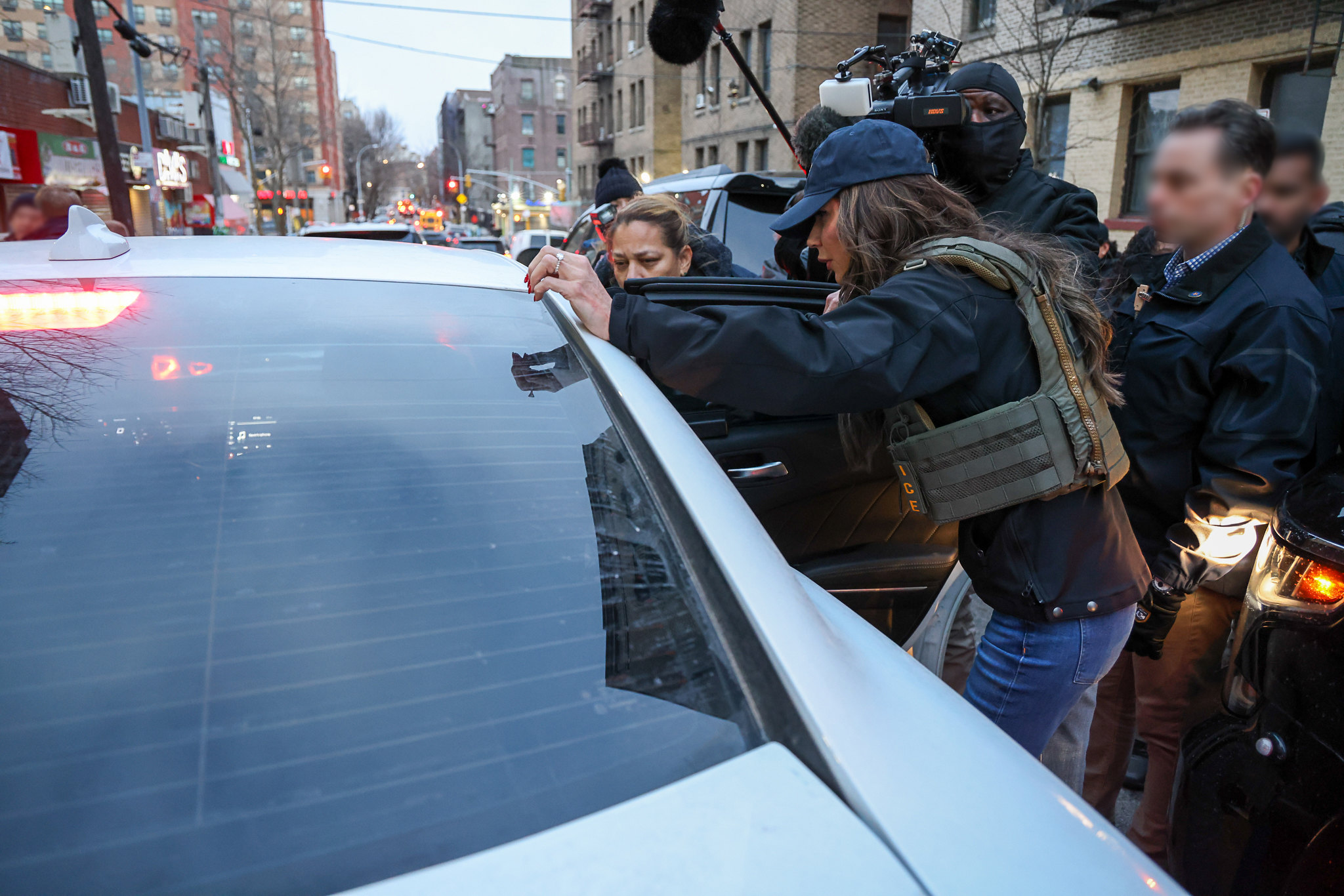
ICE agents during immigration enforcement
"It's good to know your First Amendment rights and know that you are protected. In tense situations, people get more scared, but it's fine to be scared."
— Davis Cuffe, Editor-in-Chief, Niner Times
Photo by usicegov

Q: What are some of the rights journalists have when covering these events?

A: First Amendment: your right to record, take photos, ask questions. That's within a public space. If it were a private area, we asked store owners if we could take pictures. There was also a situation, which we didn't encounter, where if an operation was happening, they could close off an area and if you took pictures there, your camera could possibly be subpoenaed for evidence by a judge. We were aware of that and if we were told they were working in an area, we would leave. Those were the only ones we were mainly concerned with: freedom of speech, being in the press and recording.

Q: What would you say to a student journalist who gets threatened by someone when they're within their rights to be somewhere?

A: I think it's okay to be scared or worried. Who wouldn't be? But you have a job to do and you're protected when doing your job. Others have encountered the same thing. There's no shame in being scared. But you can back up if you want to. You'll still probably get a similar story. You might miss a detail or two, but it's probably small. We're not The New York Times, so it's okay to back up. The job requires some bravery. You don't have to have it, but it helps.

Q: Is there anything else you'd say to student journalists? Anything I didn't ask?

A: It's good to know your First Amendment rights and know that you are protected. In tense situations, people get more scared, but it's fine to be scared. Know that if you're confronted or endangered, they're in the wrong. If you are arrested, you will most likely come out fine in the end. You might end up on the front page of the SPLC website, but you'll be okay. You're probably not in the wrong, you're doing your job, and it's protected by the First Amendment.

Essentially, members of the media have the same rights to access as the public.

Part Three

What to Do When You Receive a Subpoena or Cease & Desist

Do not ignore it: Legal documents often have a specific timeline, and missing deadlines can lead to severe legal consequences.

Do not respond on your own: Responding on your own could have legal implications for your organization; involve your editors and legal counsel.

When You Receive a Subpoena

Subpoenas often include requests for documentation, videos, photos, recordings, etc. You mustn't erase or alter anything.

  • Immediately contact your editor and a legal representative. If you're a freelance journalist, reach out to the Reporters Committee for Freedom of the Press, or the Student Press Law Center for student journalists.
  • Share the entire subpoena with your counsel. Your counsel will let you know which route to take, whether you should comply, negotiate, seek to nullify it, or challenge it.
  • Do not communicate at all with the party that issued the subpoena.
  • Document the entire process. This means communication with legal, communication with your editor, and the subpoenaed content.

When You Receive a Cease & Desist

A cease & desist typically demands journalists to stop publishing, remove certain content, or avoid releasing a story.

  • Notify your editor or legal counsel.
  • Preserve all reporting material: notes, interviews, photos, videos, emails, etc.
  • Continue your reporting, cautiously. A cease & desist cannot stop you from doing your job.
  • Do not share the cease & desist publicly.
  • Evaluate the letter's purpose. Some letters are used as intimidation tactics, while others may be legitimate claims of error. It is important to evaluate correctly.

From protests on college campuses and through downtowns of cities, to immigration raids, journalists are facing potentially dangerous situations in their day-to-day.

An Australian reporter was hit with a rubber bullet during coverage of anti-Immigration and Customs Enforcement (ICE) protests in Los Angeles this summer. Two journalists were arrested in Cincinnati in July while covering a similar protest. During the past six months, 151 journalists reported being assaulted while covering a protest, according to The U.S. Press Freedom Tracker. Twenty-six journalists reported being arrested or criminally charged during that same time period for covering a protest.

Journalists have a responsibility to protect themselves when covering events live. Here are 10 tips to keep yourself safe on the job:

Safety & Best Practices

Practical steps to protect yourself and your work.

01

Have a plan.

Before you set foot on scene, make sure you talk with your editor and have a coverage plan. Know what time you will arrive, how often you will check in with your editor and when your hard deadline is. Reach out to protest organizers and try to know their plan as well. Talk with your editor about safety measures you can take to protect yourself on the job.

02

Canvas the neighborhood.

If you can, check out the protest site in advance. You can also do this by studying maps and planning where you will position yourself. But make sure you account for what you won’t know until you’re there, such as a road or sidewalk closure. If your exit strategy is botched, make a new one and make sure your editor knows.

03

Secure personal and work devices.

Turn off any biometric recognition software on your phone before arriving on the scene. Authorities can use face ID or fingerprint scans to gain access to your devices, but they cannot use a passcode. The difference lies in the arguments under the Fourth Amendment (protects against unlawful search and seizure) and Fifth Amendment (protects against self-incrimination). Courts have ruled that biometric data does not qualify as testimony, whereas providing a passcode does. .

04

Write an important phone number on your arm.

Use a permanent marker to write an important phone number on your arm. In case you are detained and your equipment is confiscated, the number(s) will allow you to get in contact with someone and let them know where you are. Before arriving on the scene, make sure your editors know the nearby police stations where you would likely be detained if arrested.

05

Know your newsroom's policy for arrests while on the job.

Know the extent your newsroom will or won’t go to if you’re arrested. Incorporate that into your personal safety plan, and use that information to inform loved ones as well. If arrested, consider including it in your coverage. Journalists have a right under the First Amendment to document and record events in public. .

06

Exit strategy.

Plan for the worst, hope for the best. Before arriving, have a plan for how to get yourself safely away from the scene. Know multiple routes that can get you back to your car. Assess the location when you arrive, ensuring paths or roads you planned to use aren’t blocked.

07

Remain calm.

Remain calm and alert as you cover the protest or unrest. Follow police orders and move intentionally if the protest is mobile. Freaking out only makes the situation worse, and it potentially puts you in more danger.

08

Choose practical, distinguishing clothes.

Although it can be difficult to know what protesters will wear, try to pick clothes that won’t make you look like you’re part of the crowd. This could be some slacks and a collared shirt or blouse, for example. Try to avoid hoodies or all-black clothing. Make sure your clothes allow for full range of motion in case you have to maneuver away quickly.

09

Display credentials.

Like any event coverage, make sure you have your credentials readily available and where they can be seen. Items like a lanyard or clip-on name tag are easy solutions. Carry copies with you in case you lose your initial credential during coverage.

10

Group up.

If there are other journalists on the scene, connect with them when you arrive. You may be better off in a group of fellow journalists if there is a police confrontation. The group can help watch out for one another, monitoring if the situation is escalating.